How Does an LED MCPCB Board Improve Flashlight Performance?

Time:2026-09-25 Author:Ethan
0%

A flashlight can look simple: a small LED, a reflector, a lens, and a switch. Yet heat builds quickly inside its compact head. When the LED runs hot, its light output can drop, color may shift, and component life can shorten. That is where a metal-core printed circuit board (MCPCB) matters. It supports the LED and helps conduct heat from its package toward the board’s metal base. Small board. Big consequences.

How does a LED MCPCB board enhance the functionality of flashlights? It provides a more effective thermal path than a conventional insulating board, when its materials and construction are properly matched to the LED. Dr. Nadarajah Narendran, a lighting researcher at Rensselaer Polytechnic Institute’s Lighting Research Center, has studied solid-state lighting and its performance. A practical paraphrase of the thermal-design lesson reflected in this research is: controlling LED heat helps preserve useful light output and reliability. An MCPCB is not a cure-all. The dielectric layer, copper pattern, base material, mounting surface, and flashlight’s overall heat path all matter. A poorly fitted board can still trap heat.

In this guide, we look at how an MCPCB moves heat, supports stable brightness, and affects flashlight design. Picture a high-output LED pressed against a compact aluminum board inside a narrow flashlight head. The board can help, but the housing must carry heat onward. That detail is easy to overlook. It is also where real-world performance sometimes falls short of the datasheet.
How Does an LED MCPCB Board Improve Flashlight Performance?

What an LED MCPCB Board Is

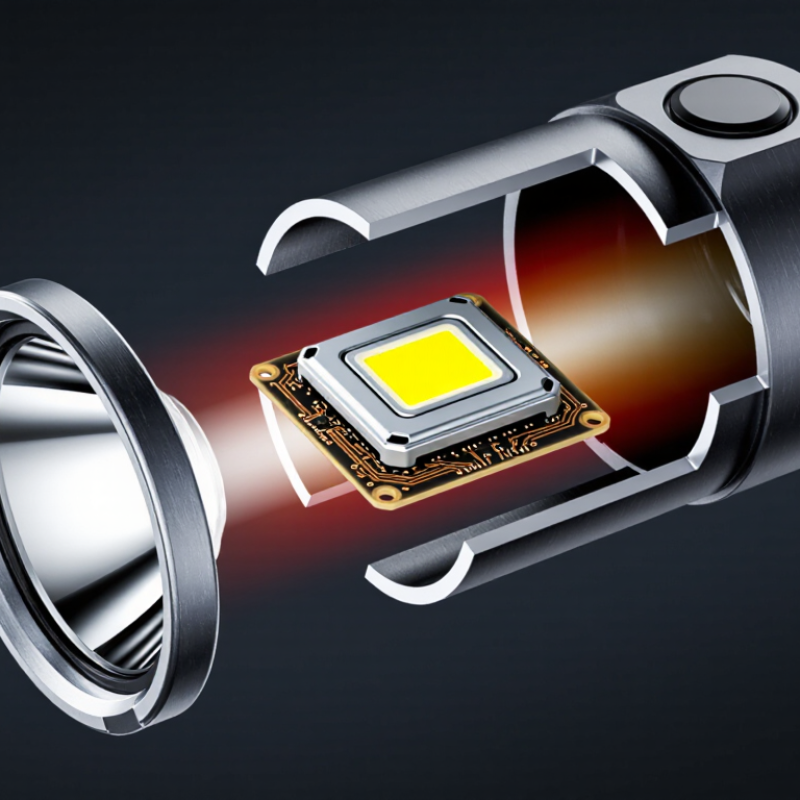
An LED MCPCB is a metal-core printed circuit board designed to move heat away from LED chips. It usually contains three layers: a copper circuit, a thin dielectric insulator, and an aluminum or copper base. The base works like a small heat spreader beneath the flashlight emitter. In practical designs, dielectric thermal conductivity often ranges from 1 to 3 W/m·K, while aluminum substrates can exceed 150 W/m·K. The numbers look impressive, but construction quality still matters.

The U.S. Department of Energy’s Solid-State Lighting R&D Opportunities report identifies thermal management as a key factor in maintaining LED efficiency, color stability, and service life. A well-designed MCPCB lowers the thermal path between the LED and flashlight body. This helps reduce heat buildup during high-output use. It can also limit output drop after several minutes. That difference is noticeable in a warm hand, especially with compact flashlights.

It is not magic.

Poor contact pressure, uneven thermal paste, or a weak dielectric layer can waste the board’s advantage. Industry testing standards such as IES LM-80 also show why LED performance must be evaluated over time, not only at startup. In my experience, the best results come from matching the MCPCB thickness, copper layout, and flashlight body material. A thicker board may improve heat spreading, but it can also increase electrical and mechanical constraints. Thermal design needs balance.

How an MCPCB Transfers Heat Away from the LED

An LED MCPCB moves heat from the LED’s tiny junction into a larger metal base. The path runs through the package, solder, copper circuit, thin dielectric layer, and aluminum board. Then heat can spread into the flashlight body. This matters in a compact flashlight, where a small LED can sit close to a warm battery tube.

Copper conducts heat at roughly 385 W/m·K, while aluminum is about 205 W/m·K at room temperature, according to ASM Handbook material-property data. Yet the dielectric layer can restrict heat flow, so a metal core alone does not guarantee cool operation. The U.S. Department of Energy’s “LED Luminaire Lifetime: Recommendations for Testing and Reporting” explains why LED temperature is important when assessing lumen maintenance and useful life. Good contact between board and flashlight body helps. So does a flat mounting surface. And the board is not magic: poor soldering or a loose fit can trap heat where it matters most.

Tips: Use a thin, even layer of thermal compound if the design calls for it. Tighten the board evenly, and check for rocking or gaps. After several minutes at high output, feel the flashlight body carefully; a warm body can indicate heat is leaving the board, though it does not confirm a safe LED junction temperature.

How Lower LED Temperatures Support Stable Light Output

How Does an LED MCPCB Board Improve Flashlight Performance?

How Lower LED Temperatures Support Stable Light Output

An LED produces heat as well as light. If that heat builds up, the LED’s output can dip during a long night walk, and its color may shift. A metal-core printed circuit board (MCPCB) provides a conductive path from the LED into the flashlight body. Its aluminum or copper base spreads heat across a wider area, helping the body shed it. The result depends on the whole thermal path, not the board alone.

The U.S. Department of Energy’s LED Luminaire Lifetime report describes LM-80 testing, which tracks LED lumen maintenance at controlled temperatures for at least 6,000 hours. These measurements show why temperature matters when evaluating long-term output; they do not guarantee the same result in every flashlight. A well-designed MCPCB can lower LED operating temperature and reduce thermal stress, supporting steadier brightness during use. Still, a cooler board cannot fix poor contact with the housing or restricted airflow.

Tips: Look for firm board-to-body contact and a thin, even layer of thermal interface material. Check brightness after several minutes, not just at startup. A small flaw matters. We often overlook the pocket lint or loose screw that blocks heat transfer; board material alone is no magic fix.

How Board Materials and Layout Affect Flashlight Efficiency

How Does an LED MCPCB Board Improve Flashlight Performance?

How Board Materials and Layout Affect Flashlight Efficiency

A flashlight’s LED can lose output when heat builds up beneath its small emitting surface. The U.S. Department of Energy’s 2022 Solid-State Lighting R&D Opportunities report identifies thermal management as an important factor in LED performance. An MCPCB helps move heat away from the LED, but its materials matter. Typical FR-4 laminate conducts heat at roughly 0.3 W/m·K, while thermally conductive dielectric layers used in metal-core boards commonly fall around 1–3 W/m·K. These are material-level figures, not guaranteed board performance.

Layout matters just as much. A broad copper area beneath the LED spreads heat; narrow traces and crowded components can create hot spots. In a flashlight, that may mean a warmer head, faster output drop, or reduced LED life. The board’s aluminum base then transfers heat toward the housing, where it can dissipate into the air. Small details count. Poor contact between the board and flashlight body can undermine a good thermal design.

Designers should check LED junction-temperature limits and measure the finished assembly under realistic operating conditions. A lab reading on an open board may not reflect a sealed flashlight after several minutes at full power. One caveat: a higher-conductivity board does not automatically make a brighter flashlight. Driver settings, LED selection, and mechanical fit all affect the result—and fit is easy to underestimate.

How MCPCB Materials Affect Flashlight Thermal Performance

Higher thermal conductivity can help move heat away from an LED, supporting stable output during operation. These are representative values for the bulk materials; the finished board’s performance also depends on its dielectric layer, interface quality, copper layout, and heatsinking.

How MCPCBs Help Flashlights Perform Under Heavy Use

During repeated high-output use, an LED produces heat faster than a small flashlight body can shed it. An LED MCPCB helps move that heat away from the emitter. Its copper circuit sits above a thin insulating layer and a metal core, often aluminum. This layered path can lower thermal resistance compared with a conventional board, provided the materials and assembly are suitable.

The benefit shows up during longer runs. With less heat bottlenecked beneath the LED, its temperature may rise more slowly, helping reduce thermal output drop and stress on the emitter. Not magic, though. The MCPCB still needs firm, even contact with the flashlight’s body or heat sink. A tiny air gap, excess interface material, or loose mounting can undermine the path. It is easy to credit the board alone; that would miss the rest of the design.

In a well-built flashlight, heat can spread from the board into the metal head, which then releases it through the housing. A warm head is normal under sustained use. It can mean heat is moving outward, not that the board has failed. Still, the driver, current level, and enclosure shape matter too. The board helps, but it cannot compensate for every thermal bottleneck.

FAQS

What does an LED MCPCB do inside a flashlight?

It moves heat away from the LED through a circuit layer, an insulating layer, and a metal core, often aluminum. It helps, but it is not the whole cooling system.

How does board material affect heat transfer?

FR-4 laminate conducts heat at roughly 0.3 W/m·K. Conductive dielectric layers in metal-core boards commonly range from 1–3 W/m·K. These are material figures, not guaranteed flashlight performance.

Why does the board layout matter?

A broad copper area beneath the LED can spread heat. Narrow traces or crowded components may create hot spots. Small layout choices count.

Can an MCPCB help during longer, high-output use?

It may help heat leave the emitter more effectively, slowing temperature rise and reducing output drop. Results also depend on the LED, driver, and housing.

How important is the board’s contact with the flashlight body?

Very important. A tiny air gap, loose mounting, or excess interface material can interrupt heat transfer. A good board can still be let down by poor fit.

Is a warm flashlight head a sign of board failure?

Not necessarily. Heat reaching the metal head may mean it is moving outward from the LED. The housing should still be checked under sustained use.

Does a higher-conductivity board automatically make a flashlight brighter?

No. Brightness also depends on the LED and driver settings. It is easy to credit the board alone, but that misses the rest of the design.

How should a flashlight’s thermal performance be checked?

Measure the finished assembly under realistic conditions, such as several minutes at full power. An open-board lab reading may not reflect a sealed flashlight. We can underestimate that difference.

Conclusion

An LED MCPCB board is a printed circuit board built with a metal core, commonly aluminum, to help manage heat produced by the LED. Its layered construction provides a path for heat to move away from the LED and spread across the board, rather than concentrating around the light source. How does a LED MCPCB board enhance the functionality of flashlights? By helping keep LED temperatures lower, it supports more stable light output, reduces the risk of heat-related performance loss, and can help extend the working life of the components.

The board’s material, thickness, copper traces, and component layout all influence how efficiently heat and electrical current are managed. A well-designed layout can reduce resistance and direct heat toward areas where it can dissipate effectively. These benefits are especially useful when a flashlight is used for long periods or at high output, when heat can build quickly. With suitable thermal design, an MCPCB helps a flashlight maintain dependable illumination and perform more consistently under demanding use.

Ethan

Ethan

Ethan is a seasoned marketing professional with a deep expertise in our company's innovative product line. With a passion for sharing knowledge and insights, he takes the lead in regularly updating our corporate blog, where he explores industry trends, product features, and effective marketing......